"In order to write about life, first you must live it." ~ Ernest Hemingway

Category: chronic illness (Page 2 of 13)

The Value of Hope

“There is no medicine like hope, no incentive so great, and no tonic so powerful as expectation of something tomorrow.” ~ Orison Swett Marden

I’ve been thinking a lot lately about the concept of hope.

That can be a bit of a dangerous thing when you live with a chronic illness that has no cure, and very little in the way of successful treatment.

But, I have a trifecta of hope happening in my life right now; a process that started sometime in April. This is ironic actually as Spring is a time of rebirth and renewal….a reawakening, if you will.

My trifecta is a combination of three things that I am doing to try and help alleviate my autoimmune symptoms, caused by Sjögren’s syndrome, and therefore increase the quality of my life. I have to be honest, my quality of life was truly beginning to take a nosedive prior to April and after about a year of this happening, it was time for some more drastic measure to be taken, both on my part and the part of my medical team.

The first part of this trifecta was starting a new biologic medication called Orencia (abatacept) on April 6th. It is not a medication for Sjögren’s specifically, but rather one often used to treat rheumatoid arthritis. However, there has been some research published and patient reports that Orencia has helped some patients with Sjögren’s syndrome, especially the symptoms of joint pain and fatigue.

The second part is that I am in the middle of (literally) an eight week Mindfulness Based Stress Reduction (MBSR) course, a program that was founded at UMASS Medical Center in Worcester, MA and since its induction, has helped thousands of patients with a variety of chronic conditions. This is something I have been considering doing for about a year or so and after the third person suggested it to me, I did my research and decided to go for it.

The third is a dramatic change in my diet, which started May 23rd. I embarked on a twelve day whole food, plant based detox cleanse with the sole purpose of trying to settle down my physical symptoms. That will end in a few days and I don’t know exactly where I will go from there, but I imagine that I will continue some version of it since I have already seen benefits.

I did not plan on doing all three of these healing and potentially life-changing things at the same time and to be honest, I would never have planned it this way. I have to travel to Boston for the Orencia infusions, the MBSR class takes three hours on Thursdays, as well as at least an hour a day of “homework” and the diet change? Of Lordy, between the shopping and cooking, that has become VERY time consuming for me. But, I did not control the schedule of when all three happened so I jumped in, trusting that God knew what he is doing.

All three of these things bring a lot of hope to the table for me, something I haven’t had a whole heck of a lot of recently. I know for certain that the dietary changes will help me and the MBSR class cannot hurt me, and my guess is I will experience some benefits from that as well. The Orencia is a crap shoot at best, however I have already experienced some positive effects from it. The real question for me is how much will these life changes help my physical symptoms, both individually and collectively? What if the changes help me so much that I am able to gain most, if not all, of my previous functioning back?

I know, that’s a tall order and honestly, any improvement would be welcome.

But, I was scared.

I was scared to hope.

Why?

Because I have been down that road before. You cannot even imagine (well, some of you can) how difficult it can be to put so much hope into something and not have it work out or have it work out just for a brief time before it is snatched away. And what you are left with is pain, more medical appointments, and disappointment. It can be challenging and heartbreaking all at the same time.

But what is the alternative? Not trying? Not taking advantage of the possibilities that are being offered to you? For me, that is not an option. So onward I went, starting with that first infusion in April.

The problem was, even though I was trying, I kept telling myself over and over that I wasn’t going to get my hopes up…not about the Orencia, or the class, or the dietary changes…none of it.

It didn’t take long though for me to realize that my self-defeating attitude regarding all of this was not exactly helpful. I then found a journal I kept during my Manifestation Workshop at Kripalu in February. The cover said, “Hope anchors the soul”” and I then saw something I had written. It was so powerful.

“I want to manifest good health and wellness.”

I WANT TO MANIFEST GOOD HEALTH AND WELLNESS!

For me, part of manifesting good health and wellness HAS to be having hope. Hope drives me. It is hope that pushes me to spend a whole day venturing into Boston for my Orencia treatment. It is the thing that help drive me through the frustration of learning how to meditate with my MBSR class. Hope is the motivation I need, when I am tired and in pain, to spend two hours in the kitchen prepping and cooking wholesome, nutritious meals.

Hope is everything.

Now, I have opened up my heart and allowed myself to hope, for many things: good health, a less disabling future, and a body that can get me through the day. Maybe I will get some of this, none of it, maybe all of it, who knows. What I do know is that throughout this ongoing process of healing, I will not give up the thought that tomorrow will be better.

Comparison is the Thief of Joy

“Comparison is the thief of joy.” ~ Theodore Roosevelt

I have a confession to make.

I have Facebook envy.

Not over things like people getting married, having babies, etc. I’m good with all the happy events and I will be the first person commenting on your joys. And, your sorrows. No, this is more about the evil jealousy monster that pops up when Facebook world seems so much easier than my world. “Seems” being the operative word here.

Sometimes it is bad, like when I am having a tough time physically and not able to get out of the house much. I open up that Facebook newsfeed, start scrolling, and my mind is assaulted of image after image of people getting together, having fun, and making memories. Many times, I am fine with it all. But then there are other times when it is just plain hard. It’s those times that I have to remember that the grass is not always greener and even if it is, who cares??

To be honest, I am guilty of excessive sharing, of what I am doing, on Facebook; which made me sit down and think about my motives in doing that. Why do I post that I am out having fun with my husband? Why do I feel the need to “check-in”? I cannot speak for anyone else, but for me personally, when I post stuff like that, it’s all about sharing my happiness with those who are important to me. I don’t collect Facebook friends; people who are on my page are people I genuinely care about, want to stay in touch with, and/or want to truly get to know better. The two people that come to my mind right away are my mother and brother. They see me struggle so much and are always supporting me. I know for a fact that they like to see when I am happy and/or doing well.

I have seen people post on Facebook, myself included, about how one cannot get a true picture of another person’s life just from reading a person’s Facebook page. I agree with that to a point, but the reality is, many people just post the happy highlights of their life. They don’t go deeper and allow us to know the unsavory or tough parts of their lives. Sure, everybody has a right to post what they want, but I try very hard to be as authentic as possible on Facebook.

So why the envy on my part? Well, like I said, some of it is based on the fact that I want to be able to be out in the world and because of my physical limitations, I often cannot do that. And, that can be very hard for me. It’s not other people’s fault, or even their problem. It’s just how it is. One of the solutions to this would probably be to spend less time on Facebook.

Then there is also insecurity and that nagging feeling I keep working on eliminating from my life. You know the one: it says “you are not good enough” or “you’re too much work.”

In addition to that, I struggle at times with feeling left out. I’m embarrassed to admit that, because it shows a vulnerable side of me that I am not always as comfortable with as I’d like to be. Feeling left out does make me sit back and think about if I have been inclusive when the tables are turned. The answer is always yes, to the best of my ability anyways. So then the question comes up for me, is it me? Is there something I am lacking in my personality? Is it the fact that because of my health, I am not always reliable? I honestly don’t know the answer to those questions, but I AM beginning to realize that it doesn’t matter. My goal as a human being should not be to worry about what people think of me or whether they like me. My goal should be to just be an authentic person doing the best she can in this world.

The funny part about all this is, when somebody talks to me off of Facebook, either in person, by text, e-mail, etc., about what they have been doing in life and the fun they may be having, I am genuinely happy for them, even on my very worst days. I don’t have “in person jealousy”. I never have. So what is it about Facebook that elicits that response in me when it is the complete opposite off of Facebook? I will get back to you guys when I figure that one out!

This week, I had a Facebook exchange with a friend of mine about a chronic illness blog entry I posted, not one of mine. A couple of things we both said stood up to me, even twenty-four hours later. I had mentioned to her that oftentimes, people are clueless about what people with chronic illness go through on a day-to-day basis and what our limitations are, especially socially. It wasn’t intended as a crass statement, just a fact. I know for me, there are maybe two or three people, who do not have a chronic illness, that get what I go through every day…not because other people don’t care (some don’t, but most do), but because they are not living my experience. The two or three people who do get it are around me enough to see the struggle and trust me, they know it’s real!

That all being said, after the exchange with my friend, it made me realize that it works both ways. Yes, most people don’t “get it”. But oftentimes, I don’t get them either. For example, I have no idea what it is like, as a woman, to work full-time and raise children. I can appreciate the struggle of that, but I can never truly “get it” because I’ve never lived it. The same holds true for for military spouses. I cannot even begin to imagine what it is like to have my spouse serving overseas and seeing them so infrequently, while keeping the household and rest of the family together. I can listen and support, but I cannot truly understand.

My friend mentioned in our exchange about how, as people with chronic illness, our lives are so different than our friends or family member. She’s right. What is important to us may not be important to them. Something that they might struggle with may be totally out of the realm of possibility for us. But I guess that is the point I am trying to make. It doesn’t have to be us vs. them. Sometimes people don’t want to make the effort to understand a person with a chronic illness. And sometimes we are just too damn tired to make an effort to understand them. But, amazing things can happen when we make an attempt to meet somewhere in the middle. Compassion goes a long way to mutual understanding.

One of the best things a friend ever said to me was this: “I don’t understand what you go through day to day, but I’m sure it’s hard. I’m here.” That’s it. That simple. Can you imagine what it would be like if we ALL said that to our friends and family?

Despite all this writing, my message is simple: don’t compare yourself to others.

You are on this earth for a reason.
You are a miracle.
Shine bright.

How Sjögren’s Has Affected Me

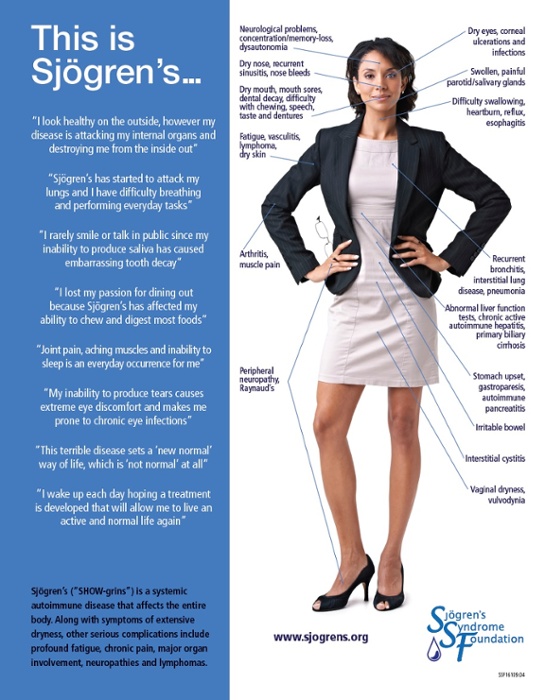
Photo courtesy of the Sjögren’s Syndrome Foundation

Today is April 1st, the first day of Sjögren’s Syndrome Awareness Month. Despite the fact that Sjögren’s is one of the most common autoimmune disorders out there, most people have not heard of it and many doctors do not know how to appropriately treat the illness or its complications.

The Sjögren’s Syndrome Foundation put out a blog post today which included an updated human diagram of the different systems that Sjögren’s affects. Oftentimes, Sjögren’s is looked at as solely an illness that causes dry mouth and dry eyes. To start with, the dryness that accompanies Sjögren’s is no small matter. Dry eyes can cause serious ocular complications, including vision loss and dry mouth can cause difficulties with swallowing and rampant tooth decay. In addition to dry eyes and dry mouth, Sjögren’s can adversely affect just about every system in the body, as illustrated in the SSF’s diagram above.

I have been doing this blog for a while now, so I don’t remember if I posted about my specific Sjögren’s symptoms, but I seem to think that I never have done so. This blog entry is going to be about that…the Sjögren’s related symptoms that I have had to deal with since my journey with this illness began. Please don’t panic! It does not mean you will have the same symptoms or even have it as severely as I do. But, it is important to be as informed as possible. Only YOU  are going to be the person driving the bus towards wellness.

* Dry eyes: An eye doctor picked up on this well before I even noticed my eyes were dry. I believe it was probably my very first symptom and it occurred well before the disabling symptoms occurred in 2008. The first eye doctor I had picked up on the dryness during a routine eye exam and I completely blew off his suggestion to start using eye drops regularly. That was, until the dryness became uncomfortable and once that happened, there was no going back. I have experienced mild corneal abrasions from the dryness. The abrasions have not been a problem since I started working with my new eye doctor. He diagnosed me with Meibomian Gland Dysfunction which subsequently changed the treatment I was doing. The dry eyes are still a daily issue for me, but the severity has lessened some.

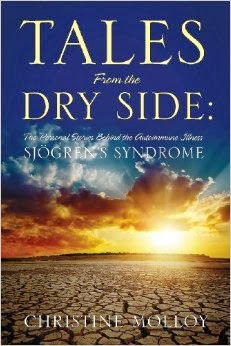
* Joint and muscle pain: If you’ve read my story in my book Tales From the Dry Side, you will know that joint pain was the first major symptoms I had that became disabling. Muscle pain followed a few years later. My joint pain often occurs in my finger and toe joints, wrists, elbows, shoulders, ankles, and knees. The muscle pain is widespread The intensity varies dramatically and is oftentimes activity dependent. I have also noticed a trend in stress and diet exacerbating my pain levels. The treatments I have tried are numerous and if you want details, please feel free to e-mail me.

* Respiratory difficulties: This is a tough one for me to describe. It was the second debilitating symptom I had which started in 2008. I call it asthma just for simplicity, but it is not asthma in the traditional sense. My pulmonologist has also called it reactive airway disease. I have had abnormal pulmonary function tests and at times have required inhalers that are typically used for COPD. This particular issues has improved dramatically for me in the past few years, since I started getting allergy shots actually.

* Reflux and esophageal motility disorder: I have had some serious bouts of reflux since getting sick. At one point, in 2012, I was vomiting all of my food and ended up hospitalized. After more tests than I care to recount, I was told that I have an esophageal motility disorder called nutcracker esophagus which means the muscles in my esophagus don’t contract and relax the way they should. Medication helped tremendously for a while and I was able to wean off of it. Once in a while, it acts up on a much smaller scale. The reflux is being controlled with alternative medicine supplements.

* Interstitial cystitis (IC): I get angry about this one. I suffered with what felt like UTI pain and symptoms on and off for almost a year before somebody recognized I had IC. I kept getting tested for a UTI and then was told the symptoms were in my head. It took a third doctor (a urology specialist) to diagnose me correctly. I had a procedure done and changed my diet and I have been stable for several years now.

* Fatigue: If I could get rid of one symptom for the rest of my life, this is it; even more so than the pain issues. Because no matter how much rest I get, if I am not on steroids, I am chronically exhausted. I do have a little control over the fatigue in terms of getting a lot of rest and/or watching my stress, but it never really goes away. There are just varying degrees of it. And, it really affects my day-to-day life, my ability to work, and my relationships.

* Dry mouth: I didn’t develop this symptoms until I had been sick for a few years. Once I did, my mouth went haywire. The biggest difference in the severity of my dry mouth has been seeing an oral medicine doctor.

* Salivary stones/blockage/infection: Due to the lack of salivary flow and changes in the consistency of my saliva, due to Sjögren’s, I have developed salivary stones. I also get swelling. On one occasion, I got a major blockage and infection on one side that required steroids and antibiotics to clear. The oral medicine doctors suctions out the stones every few months, which has helped me significantly.

* Neuropathy: This is something I am currently in the process of being tested for. I would say for me, it is the second worse symptom, after fatigue. Peripheral neuropathy causes nerve pain and itching in my legs and feet, sometimes making walking a huge challenge. I have also been experiencing dizziness from changing positions and from standing more than a few minutes. I have come very close to passing out more times than I can count. I’m also experiencing dramatic temperature swings. This may all be related to something called autonomic neuropathy. The jury is still out on that. But all the evidence is pointing that way.

* Dry nose: This has resulted in painful sores and staph infections in my nose.

* Dry skin: Probably the lest dramatic of my symptoms, but annoying enough to merit a mention!

* Raynauds: This is a lovely disorder that occurs when your hands and/or feet experience severe cold intolerance and this impacts your circulation. The hands/feet undergo color changes and the process can be quite painful.

* Sinus inflammation/infections

* Brain fog/memory loss: I had testing done several years ago that showed I had memory loss. Since then, I have been working hard on my memory issues, but that, as well as the brain fog, is still very much an issue at times.

* Rashes/photosensitivity: The frequent rashes have diminished over the years, but I still have a really bad time in the sun. When my husband and I were in Florida a few years ago, despite using SPF 50 liberally, I got a horrible sun-related rash that took days to get under control.

The above list included the symptoms that are related to Sjögren’s. There have also been a few other issues that MAY have been related to Sjögren’s, but no definitive relationship can be proven:

* Gallbladder disease: Obviously, many people without Sjögren’s have gallbladder disease and I had several risk factors associated with it. However my observation and research has shown me that gallbladder issues are very common in people with Sjögren’s.

In addition to that, I have been experiencing a lot of stomach upset and diarrhea over the last few months. I had my gallbladder out in November of last year. I did recover but I don’t know if these GI issues are related to the gallbladder surgery or if they are autoimmune related. I will be honest, I have so much going on right now medically, it’s on the back burner.

* Guillain-Barre syndrome (GB): This happened to me in 2012 and it was seriously one of the scariest things in the world to go through. I was fortunate enough to have a mild case. There is no correlation between Sjögren’s and Guillain-Barre, but GB is also an autoimmune disease.

* Hypothyroidism: My doctor cannot determine if my hypothyroidism is related to radiation treatments I had years and years ago, or if it is autoimmune in nature.

* Vocal Cord Dysfunction: I don’t know of a correlation between this and Sjögren’s, but I do know many Sjögren’s patients who have experienced vocal cord dysfunction.

* Migraines: I never had migraines until I had other Sjögren’s symptoms, so why knows!

I would be interested in hearing about what Sjögren’s symptoms you or your loved one have experienced. Please feel free to comment below….

Where Is God In All Of This?

It’s the end of March and here in New England, the temperature is supposed to be in the 60’s. The sun is already shining brightly and I can feel the gentle breeze coming through my already opened windows.

I woke up sick for my second straight day with a cold; definitely not the worst I have ever had, but the exhaustion is unbelievable. I’m not even sure if the exhaustion is from the cold, the Sjögren’s, or both. I just know that between this cold, an exacerbation in my autoimmune symptoms, and a stomach virus a few weeks ago, I am done.

So done.

I’ve had a lot going on in regards to my health lately, specifically more joint/muscle pain, terrible pain (?nerve related) and itching in my feet and legs at night, dizziness when I stand too long or change positions, nausea, chills, you name it. I could go on and on because honestly, there’s not too much NOT acting up in my body right now, but that gets old after a while.  It feels like my entire body is pissed off and launching its own rebellion.

Partly because of all this, I have been doing a lot of thinking about God lately. And church. And faith. I will be honest, I’m kind of ticked off at God lately. And curious. Curious about the eternal question: why bad things happen to good people. More specifically, why these terrible illnesses happen to the best people.

If I sit back and think of all the people I know with autoimmune illnesses, cancer, and other life altering diseases, I would say that 95% of them are the most kind hearted, giving people you will ever meet in your life. These are the people who do volunteer work and constantly want to give of themselves to others. But here is the problem: these people, including myself, cannot do all the good they want to do in this world because they have had so many of their physical abilities taken away. As of late, my volunteer work has come to a halt and I have had to refuse just as many shifts at work as I’ve accepted; a job which calls me to be of service to others.

So what does God have to do with this?

Well, a lot.

I was told recently, and it certainly wasn’t the first time, that I just need to have more faith. God has a purpose for my pain and suffering. God will heal me. Have more faith. Pray more. Do more for others. God will answer your prayers.

I’m calling bullshit.
At least for today.

I know all the devout Christians in the room are probably freaking out right now reading this. And, I do consider myself a Christian, and a pretty strong one at that. But, I no longer believe that God is making me suffer in order to make me into a better person. I’m not even sure God is really responsible for my pain and suffering. Because surely if he was, he would have brought some healing my way by now, no? The response I have gotten to that statement in the past is that everything is on God’s time, not mine. I get that. I am not in control and honestly, that’s quite a relief. But that doesn’t answer the question of: where is God in all of this?

So then I ask God, when is enough, enough? I spent the first six or seven years of my illness thinking that God was using my illness to help others and to make me a better, stronger person. Have those things happened? Definitely. Would they have happened if I didn’t struggle so much with my health?

Maybe.
Maybe not.

Maybe I just needed to tell myself that in order to keep pressing forward; in order to not just totally give up on this life of mine that for twenty years, has been riddled with so much sickness, pain, and struggle. I have a lot of respect for those Christians who have complete and total blind faith in God and in what his purpose is for each of us. I think I may even envy those people at times. They are able to not question God or his motives. They completely trust in him to take care of them, no matter what. I have had periods of time like that, but more often than not lately, I doubt all of it.

And you know what? I think that is OK. For me, a faith based on doubt, as well as belief, is a faith of my true self. The questions I ask and the doubts that I have are because I seek answers, rather than blindly ascribing to beliefs that others want me to believe. Because at the end of the day, it’s not between me and other people. It’s not between me and my church. It’s between me and God. For me, sometimes it just comes down to the basics…

Do I believe in God? Yes
Do I believe Jesus died for our sins and rose from the dead? Yes
Do I believe in a loving and non-bigoted God? Absolutely

What I also do know is that I have more questions than answers right now and the heaviness of all that this morning was tremendous. And I was upset. So I decided to go beauty hunting, a concept that was introduced to me by Jennifer Pastiloff, an amazing yoga teacher, writer, and human being. To me, beauty hunting is the same as looking for God because in essence, God is the creator of, and is a part of, all that is beautiful in this world.

I thought that beauty hunting would be a challenge since getting out of bed is a challenge in itself this week. But once I opened my mind up to the process, it just sort of happened. I started by going to the fish tank because my husband told me, when he left for work this morning, that our new starfish was making an appearance in the front of the tank. This is a BIG deal because first off, I am obsessed with starfish and secondly, we just got him. He spends a lot of time hiding in the back of the tank or in between all the rocks. But today, he was out and about for me to enjoy.

While I was at the tank, our little clown fish, Nemo, also came to the glass to look at me. The bonus though was that our Watchman Goby fish came out of HIS hiding spot, which is not only a rare occurrence, but it was the longest I’ve seen him out and about since we got him a few weeks ago.

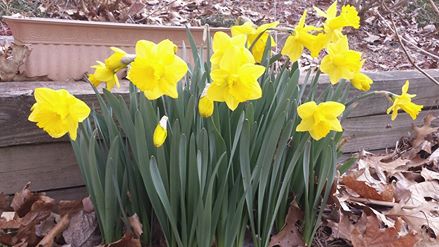
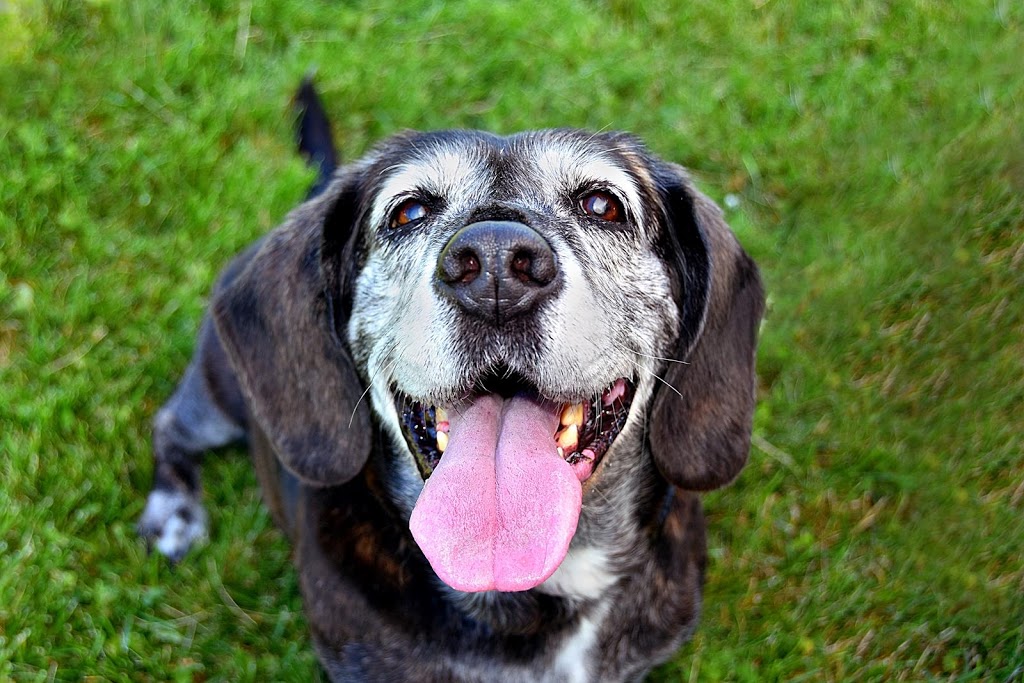
Part of the reason I woke up so annoyed was because it is so beautiful out today and I am stuck at home. So, I took my 14 1/2 year old dog, Molly, out in the backyard so she could get some fresh air. Apparently, I needed the fresh air just as much. We found that my second favorite flower, our daffodils, were fully in bloom and looking beautiful and so I decided to sit on the deck with Molly for a bit.

There is something magical about our back yard. Despite the work it needs and the fact that we have college student renters for neighbors all around us, it is so peaceful. There are birds abound and rustling trees that instantly relax you. We recently had a new deck installed and it is just glorious for sitting outside and appreciating nature.

 After a few minutes, I heard our resident woodpecker go into action on a tree. I think they are the coolest. Next thing I know, I decided to lie down on the new deck, in my pajamas, with Molly sitting beside me. We were looking at the perfectly blue sky and all of a sudden it hit me: God was there. All of those things I noticed beauty in this morning? That was him, his creations.

It was almost as if he was telling me “”I’m here. Don’t give up. Here is the beauty in this day for you.”

And just for today, that was enough.

Guest Post by Christina Griffin: Ehlers-Danlos Syndrome

My story starts many years ago, but I was diagnosed with Primary Sjögren’s syndrome at the age of forty-two. I also have Ehlers-Danlos (classical type) as do my daughters. Ehlers-Danos syndrome (EDS) is an inherited connective tissue disorder. Connective tissue is a mixture of proteins and substances that provide strength and elasticity to the structure of your body. When the connective tissue is defective, as in EDS, it becomes difficult to do every day activities.

It all started when I was young. I had a lot of health and pain issues. I had frequent joint pain in elementary school that was brushed off as “growing pains”. I remember the knee and massive leg pain. I had kidney reflux, which meant frequent urinary tract infections. At eleven years old, I was diagnosed with scoliosis and close to needing a brace at fourteen years old. I also had a lot of stomach issues which can be related to connective tissue disorders. I also had an injury from when I fell on the ice at age twelve. I’m not sure if that was related to EDS or not. I had to sit on a doughnut for four weeks, had a lot of trouble walking, and it was the start of many back problems.

As a teen, the knee pain got worse. I was wearing soft braces, which did nothing. I also started rolling my ankles frequently, which resulted in swelling and ankle sprains. I was told by doctors that I was just trying to seek attention. Nobody really knew how much pain I was in at the time. At the age of fifteen, I was in gymnastics. I did a front forward handspring and that was the end of my gymnastics days. I had hurt my back to the point of not being able to walk.

In adulthood, I noticed how often I got bruised for no reason. Scars wouldn’t heal. I also couldn’t hold Novocaine in my tissues when having dental work. Sometimes it would take up to five shots of Novocaine before I would get even a little numb. I never got completely numb though.

When I had my first child, I suffered a fourth degree tear during labor and also tore into my colon. Now, I have pelvic floor dysfunction, which can also happen as a result of EDS. It can cause severe pain, leaking,and prolapse. At age twenty-four, I dislocated a joint in my foot just by walking in my house and catching my foot on a door jam. It was fully dislocated. I started having more pain, but I got used to it. I went to the emergency room and to my doctor, but nobody caught on that something was wrong or that I had some type of underlying issue.

Finally, when I was forty-two and newly diagnosed with Sjögren’s syndrome and fibromyalgia, I was diagnosed with EDS. By then, I was walking with a cane. I used to be able to walk over three miles, but I couldn’t walk 1/4 of a mile without my cane at that point. When I learned there were others out there and that they were getting results with physical therapy, I wanted to learn more. Frustrated with my situation, I started working with a physical therapist who was very knowledgeable about EDS and  she worked with many clients who had the disorder. Within six months I was walking again, without a cane, for up to two miles. I have super flexibility in my SI joint, back, and hips. I wear an SI belt to assist in my walking as well as an ankle brace, braces for my bottom thumb joint, and braces for my fingers. All of these help my daily mobility. If I do not wear them, the pain gets worse.

My daughters have also been diagnosed with this disabling condition. Just a month ago, my primary doctor diagnosed my oldest daughter (21) wwith EDS, based on her flexibility, dislocations, and pain. What made her get diagnosed? She was having hip pain that significantly affected her mobility. At one point she had arrived home, got out of her car slowly, felt severe hip pain and the next thing she knew, she woke up on the pavement, outside of her car. She had passed out from the pain. Now she is in physical therapy and is showing signs of improvement.

My younger daughter (19) was diagnosed when I was and has had many painful days, but she has strengthened her muscles and now moves better. She is also on pain medication, which does help. This condition can require heavy duty pain medications just to be able to get through the day.

I am just happy they were diagnosed much younger than I was. At least they can both get treatments and hopefully avoid using canes and wheelchairs for most, if not all, of their lives. They are also aware of the condition for the benefit of their own children.

This disorder almost stole my mobility from me. But I am determined to do whatever it takes in order to keep a relatively decent amount of mobility for myself, for as long as I can. I plan on taking hikes this year and I walk four times a week, all braced up. I don’t do anything that will be strenuous on my joints (including yoga) and I avoid stress as much as possible. I stay as active as I can, and I give myself a break on bad days. I am aware of the consequences of this disease and I know that I could end up being in a wheelchair, but I no longer let that stop me. My best advice for someone newly diagnosed with EDS is to talk to your doctor now about you can keep the mobility you have now, or even how you can get any back that you may have lost. Take it easy on yourself when the pain gets bad and most of all, don’t give up!

*********************************************************************************
Christina Griffin is a student teacher, wife, a mother of four, and a grandmother of three. Her diagnosis of severe and life-threatening food allergies came in 2010 and then snowballed into a diagnosis of Sjögren’s syndrome, fibromyalgia, PTSD, anxiety with memory loss, and EDS. Christina spends her free time finding learning activities for her students, studying, watching Gilmore Girls, gardening, walking/hiking, and reading. She also enjoys music (both playing and listening), and writing.

« Older posts Newer posts »