"In order to write about life, first you must live it." ~ Ernest Hemingway

Category: chronic illness (Page 5 of 13)

Accepting Sjögren’s

I wasn’t planning on doing any writing today but to be honest, I need to write. Actually, there are many times that I need to write. I cannot even tell you how many times I come to this blog to write about how I am feeling regarding living with this illness and instead of blogging, I close down my computer and walk away.

Why?

Because I feel like I don’t have anything positive to say.

And it has come to my attention lately that this is probably not the healthiest way to deal with the psychological impact of having a chronic illness. Of course, I already knew that fact, but I never seemed to think that it applied to me. I thought that the best way for me to get through day after day with this heavy burden that is called Sjögren’s syndrome, was to stay upbeat and positive.

Put on a smile.
Be grateful for what you have.
Make the best out of a lousy situation.
Hell, write a book about it even!

And you know what? I DO believe that keeping a positive attitude is a key element to living well with chronic illness, no doubt about that. However, I now realize that in my efforts to keep myself from getting down and out, I have placed this unrealistic expectation on myself that I need to be upbeat and positive all the time when dealing with others, especially in my writing. I try very hard not to complain whether it is online on social media, or with my friends and family. And I think that is a disservice to us all.

The exceptions to this are my husband, my parents, and my brother. They get the real deal, 24/7. Why? Because they are “safe”. I don’t worry that they will judge me, end a friendship with me, or realize that being in a friendship/relationship with someone like me can be really hard at times. It is not for the weak or for those who cannot handle the unpredictability of what this illness brings. They see me at my worst and love me anyways.

But, living like that is exhausting.
And I cannot keep it up.

I am here to tell you that Sjögren’s syndrome sucks. It is this pervasive and debilitating illness that NEVER gives you a day off. Every single morning I wake up knowing that at the age of 43, I am never going to have a day again where I am completely healthy. It will never go away. It will follow me every single moment of every single day until the day I die. And hopefully, that will be because of old age, and not because of Sjögren’s complications.

That is not a negative attitude.
That is called acceptance.

Acceptance is what frees you. It is acknowledging the reality of the situation while at the same time, making a plan to live as wholly and completely as you can, despite it all. It is knowing that you can do anything you set your mind to while at the same time knowing that doing some things are not worth the price you will pay in the end.

Acceptance is being your genuine self. Not pretending to be fine when you are not. Knowing the value of letting people see how things really are. How exhausted you are or how much pain you are in. How discouraged you are when you spend half of your work week in doctor’s appointments.

Acceptance is having and using the ability to say “no” to people and requests, especially the ones that come from people who don’t try to understand, or maybe don’t even care about, your limitations or restrictions. Maybe its saying no to a trip that you know will be difficult or a stressful situation that may exacerbate your symptoms.

So I am going to work on acceptance and I will forewarn you, it probably will not be pretty at times. It will involve being more honest and I’m sure, using more swear words because that is just what I do. I am aiming for progress, and not perfection.  Maybe you can too…

Revisiting Low-Dose Naltrexone (LDN)

“LDN may well be the most therapeutic breakthrough in over 50 years. It provides a new method of medical treatment by mobilizing the natural defenses of one’s own immune system.” ~ David Gluck

I have previously posted at least twice about my trials with a little-known medication called low-dose naltrexone, LDN for short. You can read those previous entries HERE and HERE.

However I have decided that it is worthy of another post, because I am about three weeks into my third trial with it and I have recently learned more about the medication.

Naltrexone is a prescription medication that has historically been used in larger doses to treat alcohol dependence and opioid addictions. Since the 1980’s, some doctors have discovered that it can be used in smaller doses, hence the name LOW-dose naltrexone, to successfully treat some chronic illnesses, specifically autoimmune diseases, cancer, HIV, fibromyalgia, etc. It accomplishes this by regulating cell growth and slowing down cell proliferation. For autoimmune diseases, this cell regulation results in the immune system being reset.

LDN, at doses of 1.5-4.5mg per day, works by blocking the opioid receptors in your body for approximately four hours. The body is tricked into thinking it is not producing endorphins, specifically those called Opioid Growth Factor (OGF). The body then compensates for this by increasing production of these opioids and their receptors, producing a rebound effect.

LDN was first introduced to me in early 2013 by my integrative medicine practitioner. It has successfully been used to treat Multiple Sclerosis and Crohn’s Disease in some individuals. My practitioner thought that it may be of use in Sjögren’s syndrome. The problem is not many people have heard of it and there haven’t been many studies done on its positive effects; although there were a few studies done with Multiple Sclerosis and Crohn’s patients which showed its benefits. LDN is a very inexpensive drug and is already available as a generic preparation, so of course research studies do not get big funding from the pharmaceutical companies and the drug remains underutilized. There are some grass roots groups that have been trying to get the word out there and that is the primary reason why I decided to do another blog entry about it.

So you are probably wondering why I am trying this medication for the third time. I have actually had some good success with it, however the side effect of insomnia has been enough of a problem that it has caused me to go off of it during one of the trials. Also, the last time I was on it, I was admitted into the hospital and put on narcotic pain medication for an issue that had nothing to do with the LDN. You CANNOT take LDN while you are taking narcotic pain medications. The only possible exception to this is Tramadol which I have been able to take, only on occasion, and I try to space it four hours apart from my LDN dose.

LDN is a compounded medication. I get mine compounded by Skip’s Pharmacy in Boca Raton, Florida and it is shipped to my house. They also do a vegetarian capsule which is dairy-free. The owner, Skip Lenz, is a pharmacist who is considered an expert on the use of LDN and he is a very valuable resource. This is not a medication that all pharmacies know how to prepare in terms of fillers, etc. so do your homework on this. And do NOT get it in a slow-release form. The total cost, with shipping, runs me somewhere between $22-$28/month. Insurance does not cover it, but that is cheaper than many of my insurance co-pays.

Ideally, you should work with your doctor in regards to using LDN. But, if you want to try LDN and cannot get a doctor to prescribe it for you, you may contact Crystal Nason by email at this address: LDNDrListRequest@aol.com. Put LDN Prescribing Doctor in the subject line and tell her where you live. She has an extensive list of doctors who prescribe LDN and I have heard she is an excellent resource for this.

I am seeing a different integrative medicine practitioner now and we talked about trying the LDN again, but this time, by starting at a much lower dose and slowly increasing it to see if I can tolerate it. The previous two times, I started at 3mg I believe. This time around, I am starting at 1 mg. I am probably going to stick with that dose for another month or so. It has affected my sleep some already, but not to the extent it did before. Oftentimes the insomnia improves over time. Typically, people say that LDN should be taking between 9pm-3am so that it works on the endorphin receptors during their peak time, which is between 2-4am. This is probably the most debated topic regarding LDN…when to take it. Other experts on the topic feel that because of the mechanism of how it works, you can take it at any time of day. Because I have already started with some insomnia (I fall asleep fine, but wake up around 1 am for a while and feel wired), I am trying it in the morning. It’s too soon to tell yet if that is helping my sleep as I have had some other issues affecting my sleep this week.

What I have noticed just from being on this small dose is that my typical low level anxiety that I get from time to time is gone and in general, I feel more on an even keel. My energy level has also improved a little during the day. In the past, when on higher doses, I have seen a dramatic improvement in my pain levels and energy. And that is exactly why I am working so hard to get LDN to work for me.

The thing about LDN is this: besides the insomnia and vivid dreams, there is minimal risk and side effects to taking it. OK, you have to deal with the narcotics issue but besides that, it is a relatively convenient medication to take. No life-altering side effects like all the immunosuppressants that get thrown at us; osteoporosis, diabetes, cataracts, cancer, the list goes on and on. If you are being treated for a thyroid disorder, you need to more closely monitor your thyroid levels because as LDN regulates your immune system, your TSH levels can fluctuate  and you may need a thyroid medication adjustment. And finally, as we know, not all medications work successfully for everybody.

Because the research is limited and its not well known as a treatment for autoimmune illness in traditional western medicine, there are a lot of unknowns about the medication at this low dose, the dose timing thing being a perfect example. So if you decide to try it, you are going to have to listen to your body, do your research, and find what dose and timing works best for your body and particular illness. Don’t give up on it. There are plenty of non-prescription sleep supplements to help with the insomnia if you should need it and I believe that LDN is well worth the effort. While I don’t think it is a miracle cure, I do think it can be an important component of the treatment plan.

Reclaiming Acupuncture

A couple of years ago, I went to see an acupuncturist for the first time to see if he could help manage some of my autoimmune symptoms. It was such a good experience for me, that I wrote blog entries about it and continued with my treatments for about a year. It could have been longer, I forget…

However, at some point, I stopped going because I felt that I had reached an end point in terms of my improvement, and because I had started seeing a massage therapist who did trigger point massage therapy. At that time in my illness, the trigger point therapy seemed to be helping more and both modalities of treatment were out-of-pocket and not covered by insurance. I find this fact extremely disturbing in itself because out of ever single thing I have ever tried to manage my autoimmune symptoms, acupuncture and massage therapy were two of the most effective treatments.

Then eventually, I ventured into the land of integrative medicine and while some of it is covered by my health insurance, a lot of it isn’t and that adds up after a while. So I put acupuncture on the back burner for a period of about two years, give or take.

Recently, I weaned off prednisone and started to have some nasty symptoms: fatigue like I have not experienced in well over a year, joint pain, constant menstruation (yes, that was fun), mood swings to go along with the messed up menstrual cycle, and overall just feeling like hell. It took all my energy to shower, get my daily basic tasks accomplished, and to get through the day without crying. And I mean a LOT of crying; for no reason. It felt like I was premenstrual ALL THE TIME! The days where I had to work, I would rest for a few days before and after each day I worked and I did nothing but get to work and my medical appointments.

I first thought this was all autoimmune related, but the menstrual abnormalities and mood swings made me think otherwise…like peri-menopausal otherwise. I also thought maybe it was from coming off the prednisone. I didn’t think I was under a lot of stress, because I was very happy with my life, but when I objectively looked at what was going on in my life: publication of my first book, the new job, the upheaval in my church life, some personal issues, an upcoming trip, training for a recent road race, I did have a lot of stressors in my life. Most of them were GOOD stressors, but stressors all the same.

I didn’t even know what to do about all this as I didn’t know the exact cause. I was certain that the autoimmune stuff played a role, but I didn’t think it was the sole culprit. I happened to have a scheduled appointment with my integrative medicine practitioner and I talked to her about it. Part of the problem was that I had stopped my low-dose naltrexone (LDN) because it was keeping me awake at night, which was making things worse. For the autoimmune symptoms we decided to go back on the LDN, but take it in the morning, and add back my boswellia supplement for the autoimmune symptoms as well.

She then told me she suspected I may have adrenal gland exhaustion (also called adrenal gland fatigue) from a combination of the prednisone and stress. It seemed to make sense to me. She prescribed a few specific supplements (Adreset and Adrenal) for adrenal gland support and also something to help regulate my adrenals, and subsequent cortisol levels, for sleep. I came home and researched adrenal fatigue and it was like seeing the past few weeks right in front of my eyes!

I was getting nervous because I was due to fly to Chicago for the SSF National Patient Conference in a week. Our plan was to give this treatment plan two weeks and if I was not getting better, or worse, I would have to go back on a small dose of prednisone for a while. Well, two weeks wasn’t going to help me for the trip if I didn’t get better. Then, it hit me on the drive home: why wasn’t I back at acupuncture?

So I contacted my friends at The People’s Acupuncture Clinic in Amherst, MA, which is where I used to go, and made three appointments  for the next week until I left for Chicago.

Best decision ever.

I went to my first appointment a wreck. I was so exhausted and in so much pain, I just wanted to crawl into bed and sleep for six months. Within a few minutes of the practitioner inserting the acupuncture needles, I began to feel a sense of calm and relaxation flowing through my body.

That morning, I could not even open my right hand all the way because of the joint pain and swelling. Four hours after my treatment, my hand was fine and I had NO JOINT PAIN.

None.
Swear on a stack of bibles.

By that evening, I was still very tired, but actually managed to go out for a bite to eat with some friends after church.

By the next morning, I had finally stopped menstruating and didn’t feel as moody.

Twenty-four hours later, I went for a run with my husband. It wasn’t easy, but it was doable.

It has now been six days since I started my adrenal gland and autoimmune supplements and today, I had my second acupuncture treatment since starting three days ago. And, I am better. The mood swings are completely gone, my joint pain is significantly improved, I am sleeping better, my anxiety level is down, and overall, it feels like my body is moving its way back to a more even keel. I am certain the improvement  is due to the acupuncture and the integrative medicine treatment plan. I have also worked on other ways to treat the adrenal fatigue such as getting a lot of rest, no matter what is going on, and overall, just taking better care of myself.

I definitely am not in as good a place as I would like to be in, or was in, before this all blew up on me, but I am well enough to know that in 2 1/2 days, I will be able to make that flight to Chicago. The first thing I will do the day after I get back?

Go to my acupuncture appointment….

Crossing the Finish Line

This past Saturday was an event I have been preparing for over the past five and a half months, since I started running last October: the Holyoke St. Patrick’s Road Race. 6.2 miles. 2 1/2 miles of it uphill. And, they are big hills!

This is a bit of a race report mixed with my observations on what it is like to do this type of event. I don’t know the specifics of how large other races are, but this particular race had a lot of people, reportedly over 7,000 runners. Somewhat intimidating to me. As I have mentioned in a previous blog entry, my husband was running the race by himself and my friend, Heather, and I were running together. It was such an incredible experience that it has taken me a few days to get my thoughts together before I write them down.
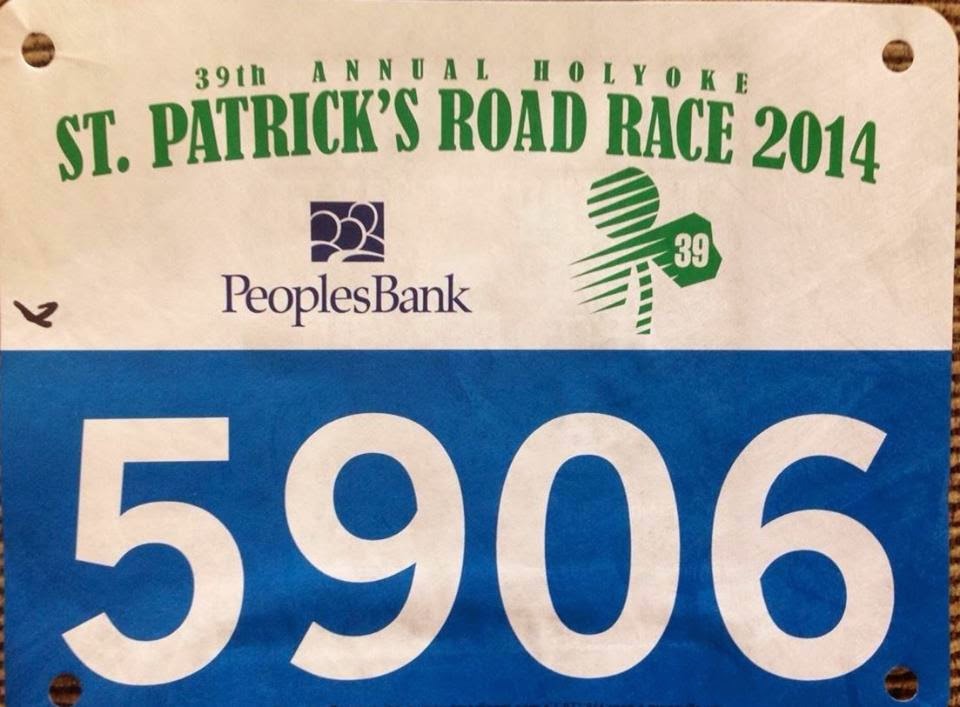
The City of Holyoke, Massachusetts takes St. Patrick’s Day seriously. The parade, which is the day after the road race, is one of the biggest in the country, maybe even the biggest. So of course, the road race is a big deal as well. People dress up in green clothes, costumes, and all kinds of other garb for the event. We were no exception. That is the reason I have pushed so hard, as a new runner, to try and get myself ready for this year’s race, rather than waiting a whole year to compete. The race is just fun. While I have been training consistently, I knew another year might have made a big difference in the difficulty of running this race for me. However being as inpatient as I can be, and honestly, none of us knows what can happen in another year, I knew I had to attempt the race this year.
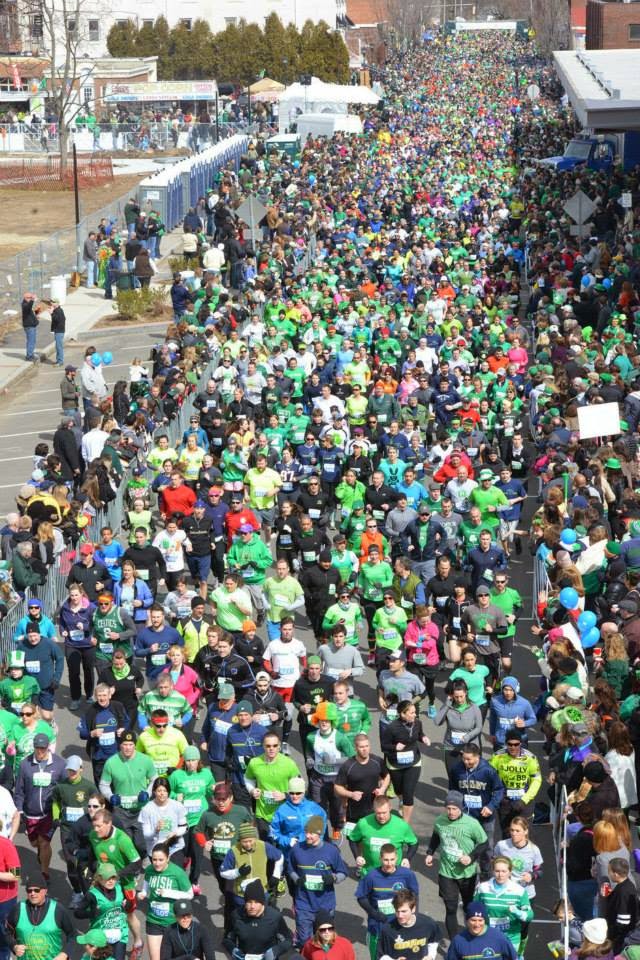
We got to the race area pretty early because of the high volume of traffic and people who were expected to be in attendance. Because for as many runners as there were (there was also a walk), there was probably just as many spectators lining the streets. After about two plus hours of waiting, stretching, and waiting some more, my husband went to his starting line up position and Heather and I went to ours, in the very back. This year, the race was starting in waves and we were going to be the last group, besides the walkers, to depart from the starting line. There was definitely a feeling of excitement as we heard the gun go off, indicating that the first wave of runners was on the move.
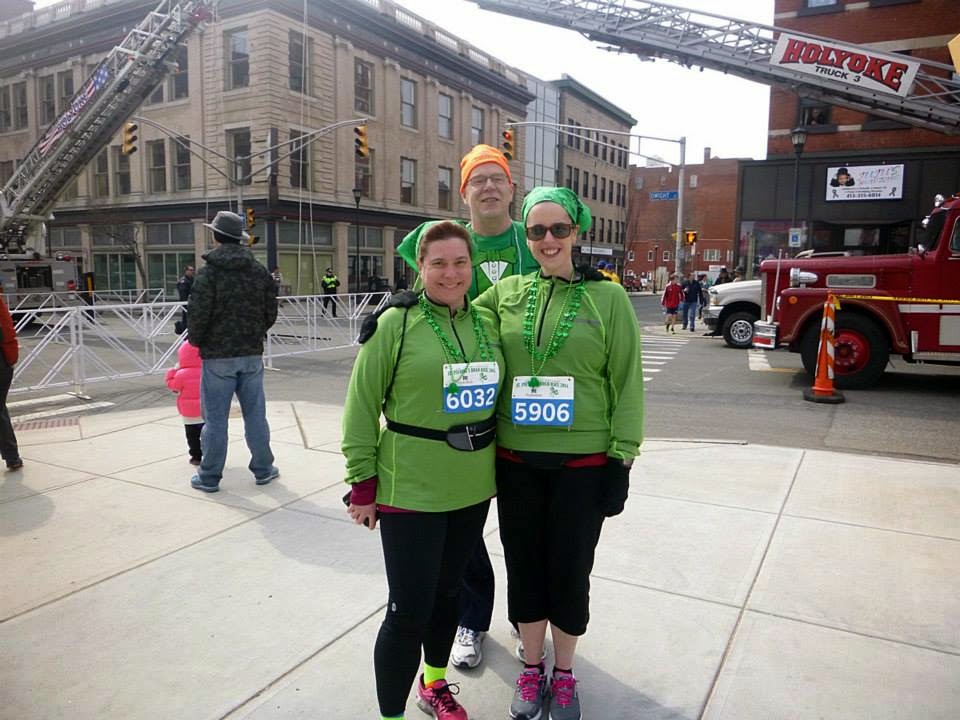
Heather and I had a plan to start the race walking for a few minutes, mostly because at my last race, I panicked and started off much too fast, causing me to have a difficult time. The other part of our plan, since we are run/walkers, was to speed walk the hills and run as much of the rest as possible. As we started off across the start line, I was shocked by the amount of people lining the barricades, rows and rows deep. I started to get a little panicky having all these people watching me.

After a very brief walk, we did start running. I tried to not be too conscious about how far back we were. I just kept reminding myself that pacing myself was the key to us crossing the finish line. However, it was hard to ignore the ambulance that was very closely trailing behind us. Being someone who has so many medical struggles and has recently spent time in an ambulance, I found this a bit disconcerting. I just kept reminding myself, “pace yourself”, pace yourself.”

Since Heather and I have been training together for months, we have developed a good pattern of communication while running and I think that really paid off during the race. There were points where she was struggling more than me and other points, especially towards the end, where I was struggling more. But overall, we stuck with the plan and mile by mile, I realized that we were absolutely going to finish, and likely at a faster time than we thought. According to my running watch, we were averaging about a fifteen-seventeen minute/mile walk and about a twelve-fourteen minute/mile run. I had thought that if we finished the race in 1:40-1:45, I would be happy. Anything under that would be an even bigger accomplishment. By my calculations, we had a shot at finishing at about 1:30. We had discussed during one of our training runs that 1:30 would be the icing on the cake, so to speak.

The experience of this race is one that I will never forget. It definitely had its challenges: leg issues for Heather, a previous injury for me, nausea after my first water stop when I tried to drink water, and WAY too many hills! That all being said, overall, it wasn’t quite as difficult as my first race on New Year’s because I had more months of running behind me and the temperature was at least  thirty degrees warmer. My family turned out to cheer us on at two different spots along the race course and it is still amazing to me how many complete strangers cheered us on along the way. I’m not talking about cheering statements like “keep going”, but rather comments like: ” you can do this….you’re almost there…you SO got this…last hill.” Comments that actually spurred us on when things got tough. There were people on their front lawns playing bagpipes, Irish music being blasted from people’s homes, and LOTS of clapping and yelling. The kinds of things you need when doing your first 10K race.
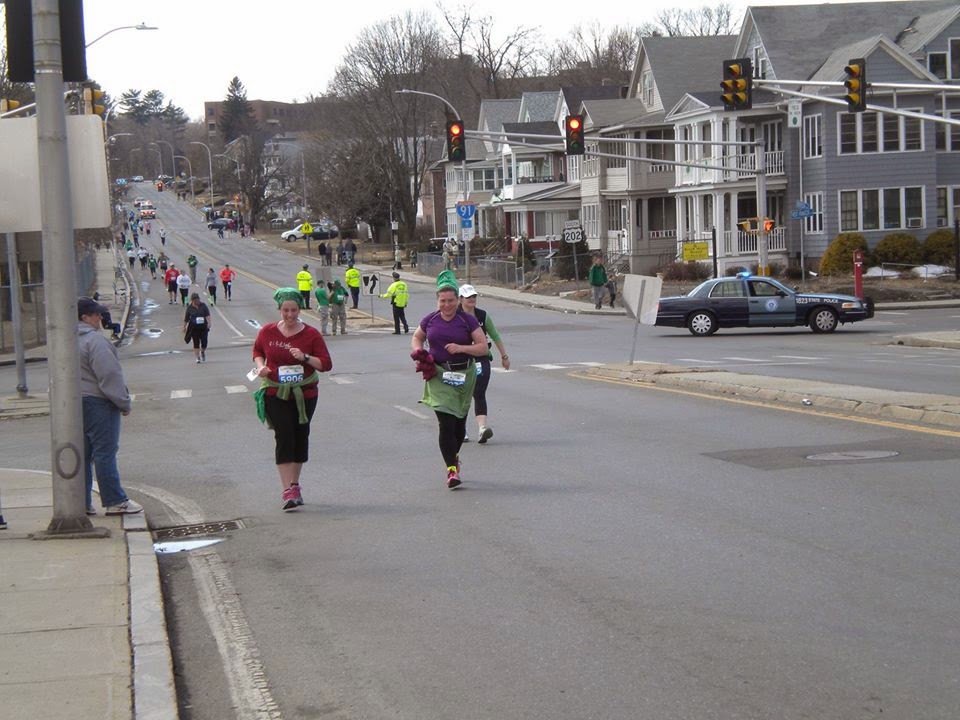
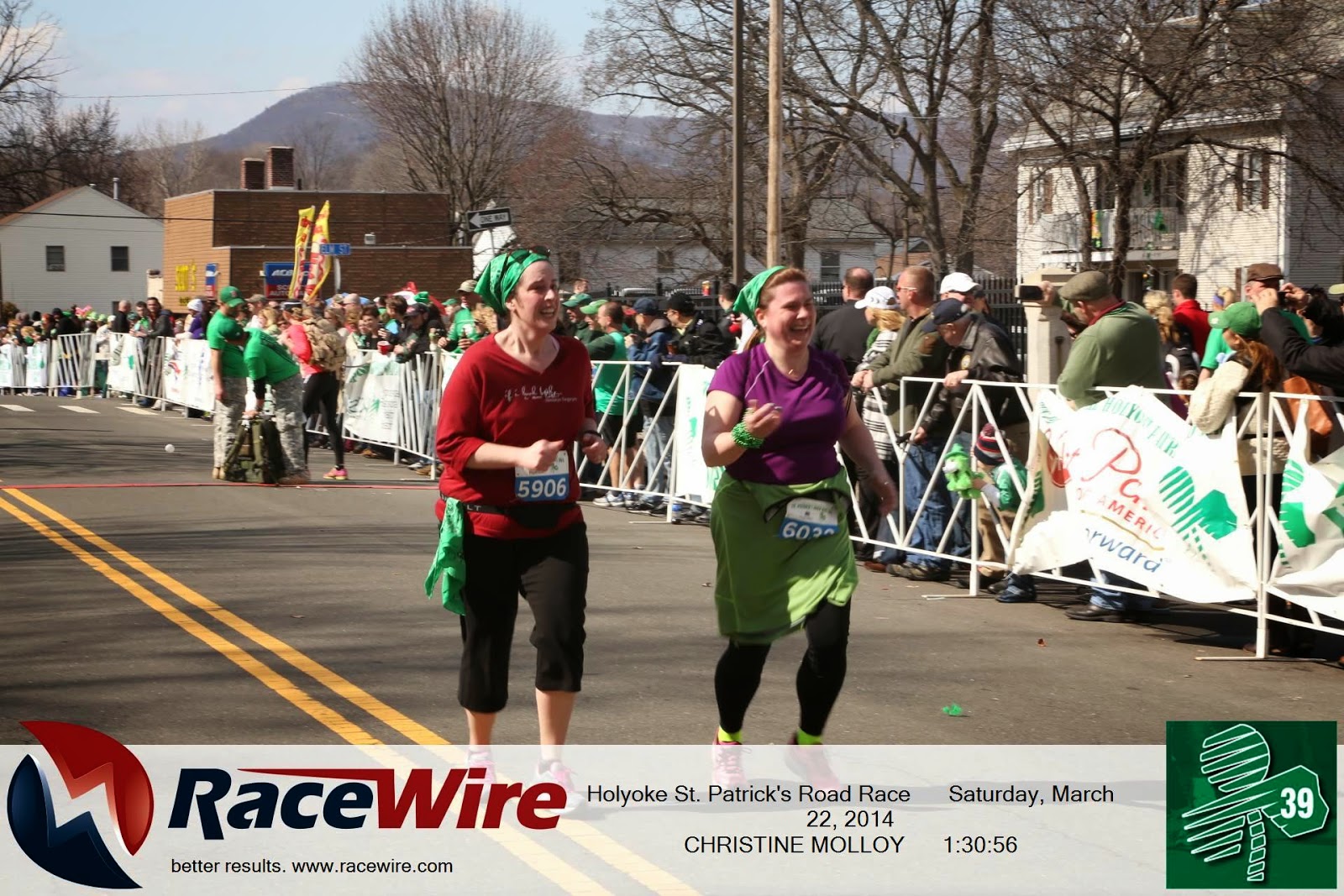
The three of us did finish the race. My husband came in at just under an hour (59:57) which was fantastic for his first 10K. When Heather and I turned the last corner to head towards the finish line, it was all I could do to keep moving and not only was I moving, but I was running. I made a promise to myself when I started running, that I would NEVER walk across a finish line. No matter how difficult running is for me or how tough a race is, I would always run my last quarter mile. I would always be a strong finisher.

It felt quite surreal when Heather pointed out how close we were to the finish line. As we got closer, we heard the announcer say our names on the loudspeaker.That is the advantage to finishing towards the end of a race, we heard our names announced because we weren’t in a pack with a bunch of another people…it was just her and I. Usually the only time my name is ever announced, I am in a medical appointment waiting room. This was a nice change of pace!

Right before we crossed, I looked up at the time: 1:40. I was slightly disappointed, although I shouldn’t have been. But I did think we had done a little better than that. It didn’t matter though. We had finished. I, a person with a life-altering chronic illness, had accomplished something that I never before thought possible, even when I was healthier.

The three us spent some time in Holyoke rewarding ourselves with some hard-earned beers (not the gluten-free variety, either) and during that time, I got a text message. The company that monitored the race, Racewire, texts your time after the race. I never even knew that was going to happen. And then, a sudden realization hit when as I was reading the text. Our 1:40 time on the finish line screen did not account for the fact that we were in the last wave of runners to start, delaying us by about ten minutes. Our actual finish time was 1:30:56! We did achieve what I previously thought was unattainable. Was a 1:30 finish time a remarkable feat in the world of competitive racing? Not by any means and I know that. But that doesn’t change the fact that for us, it was truly a remarkable feat.
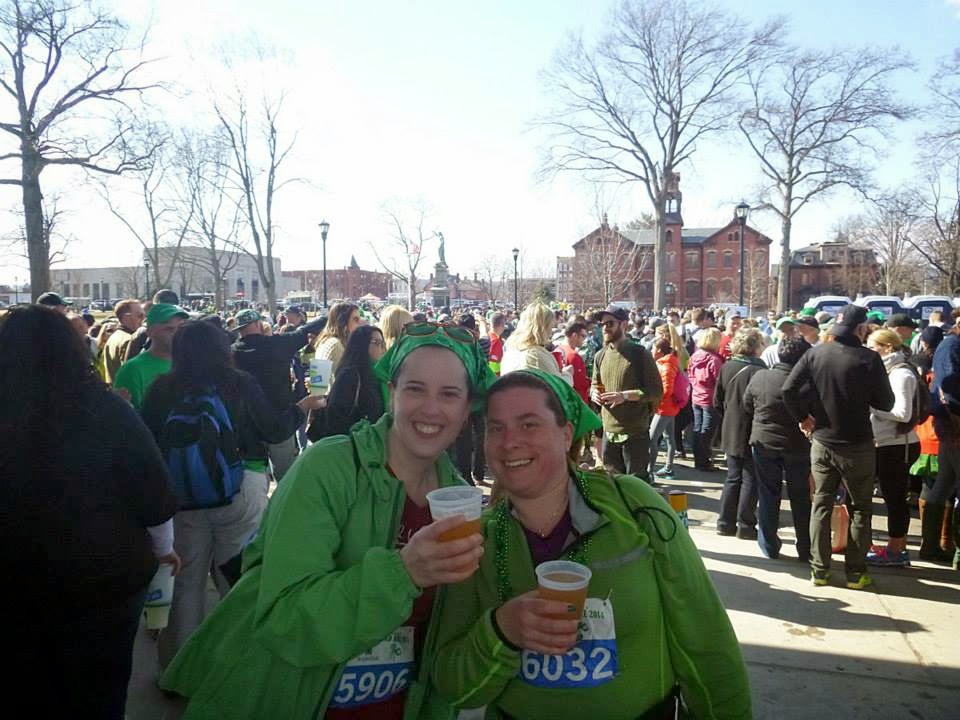
The aftermath of running the 10K has been difficult for me; a lot of it has been ignorance and neglect on my part in post-race recovery. More of it has been my usual daily physical struggles exacerbated by putting my body through an unusual physical challenge. And finally, part of it has been a nagging leg injury that is totally ticked off at me for running all those miles. But as uncomfortable as I am, it still doesn’t feel as bad as my worse day as a Sjögren’s patient because mentally, I am stronger and I feel like I have accomplished something that I was never supposed to do.

My only question now is: when is the next race?
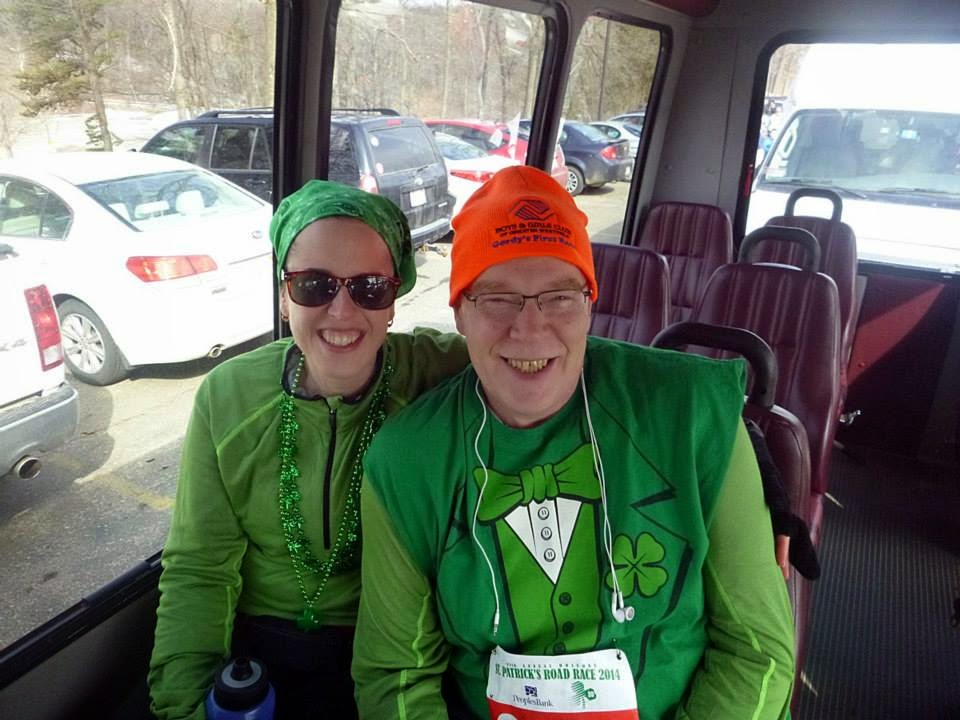
The Power of Running

I just finished my last training run in preparation for a race that I am running (I do a run/walk combination) in four days. The race is a 10k event (6.2 miles) and is the second race I am going to be competing in since I started running five and a half months ago. The first one was a 5k (3.1 miles) on New Year’s and since then, I have been training for Saturday’s race with my friend, Heather. My husband is also going to be running that day, albeit at a much faster pace than Heather and I.

This race is a big deal for me. Two and a half miles of it is uphill and honestly, I have never even ran 6.2 miles in my whole entire life. I have done three miles…four miles….and a one-time five miler, but never more than that. But, I have been consistent with my runs and since I am still dealing with some type of upper leg injury that has yet to be resolved, that is a major accomplishment. Actually, it is a major accomplishment that I can even run at all considering the physical obstacles I have endured and worked through over the past several years. I cannot lie though, I am a little scared. Scared of how my body is going to react to pushing it further than it is probably ready for.

I have been wondering lately how the heck I got here; what fuels me to want to do this running thing week after week. I know a big part of it is the endorphins and how good they make me feel. When I started a new job recently, I took almost a week off from running to try and manage the overwhelming fatigue I was having from going back to work after five years at home and you know what? I missed it, a lot. Running has become my primary way to deal with stress. A much healthier way than eating my way through stress.

So many other aspects of my physical self have improved over the past few months. A few nights ago, I went to scratch an itch on the back of my leg and when I touched my leg, I felt what I thought was swelling. Because of the Sjögren’s, I get all types of weird things that pop up here and there and I am very in tune to any changes in my body. Well, apparently not that in tune because as I felt my leg more thoroughly, I realized what a fool I was. My leg was not swollen or messed up from autoimmune issues…. I had developed some serious MUSCLES in my legs. It still amazes me when I look at my legs. They don’t look like mine at all anymore.

My cardiovascular status has improved significantly. My knees no longer hurt at all when I run and when I first started running, my knees hurt so bad, I didn’t think I would be able to continue running. My asthma has remained stable and despite the fact that I am on the lowest dose of prednisone I have been on in six months, I can run/walk three miles in less than fifty minutes. Not a world record breaker by any means, but a success nonetheless.

I realized something this afternoon though. It was one of those breakthrough moments as I was driving home from our training run. I was crying in the car because of this realization. Aside from all the physical benefits that becoming a runner has given me, I have figured out the one major reason why I love running so much, despite all my constant complaints to my husband about how much I hurt sometimes:

Running makes me feel powerful.

RUNNING MAKES ME FEEL POWERFUL!

When I run, I am not a patient. I am not an illness.

When I run, it is me and my body battling itself, and I always win. Some days more so than others. But the fact that I get off the couch and go, that is me winning.

When I run, I do not feel like the fat girl who was teased in gym class for being so slow and awkward. I feel the strength in my legs and the air racing in and out of my lungs. I am not the awkward fat girl. I am a runner.

When I run, I hear the soothing rhythm of my feet striking the ground.
The sound of power.

Running makes me feel powerful because I am doing what I was told I would never do. It is me defying the odds and refusing to let my illness or my own mind beat me. It does not matter if I am running a twenty minute mile or a thirteen minute mile, me and my body are beating the odds. It may last another week. It may last the rest of my life. But regardless of the outcome of my running life, or even this race Saturday, I have conquered.

« Older posts Newer posts »